# How Tactical Voting Works
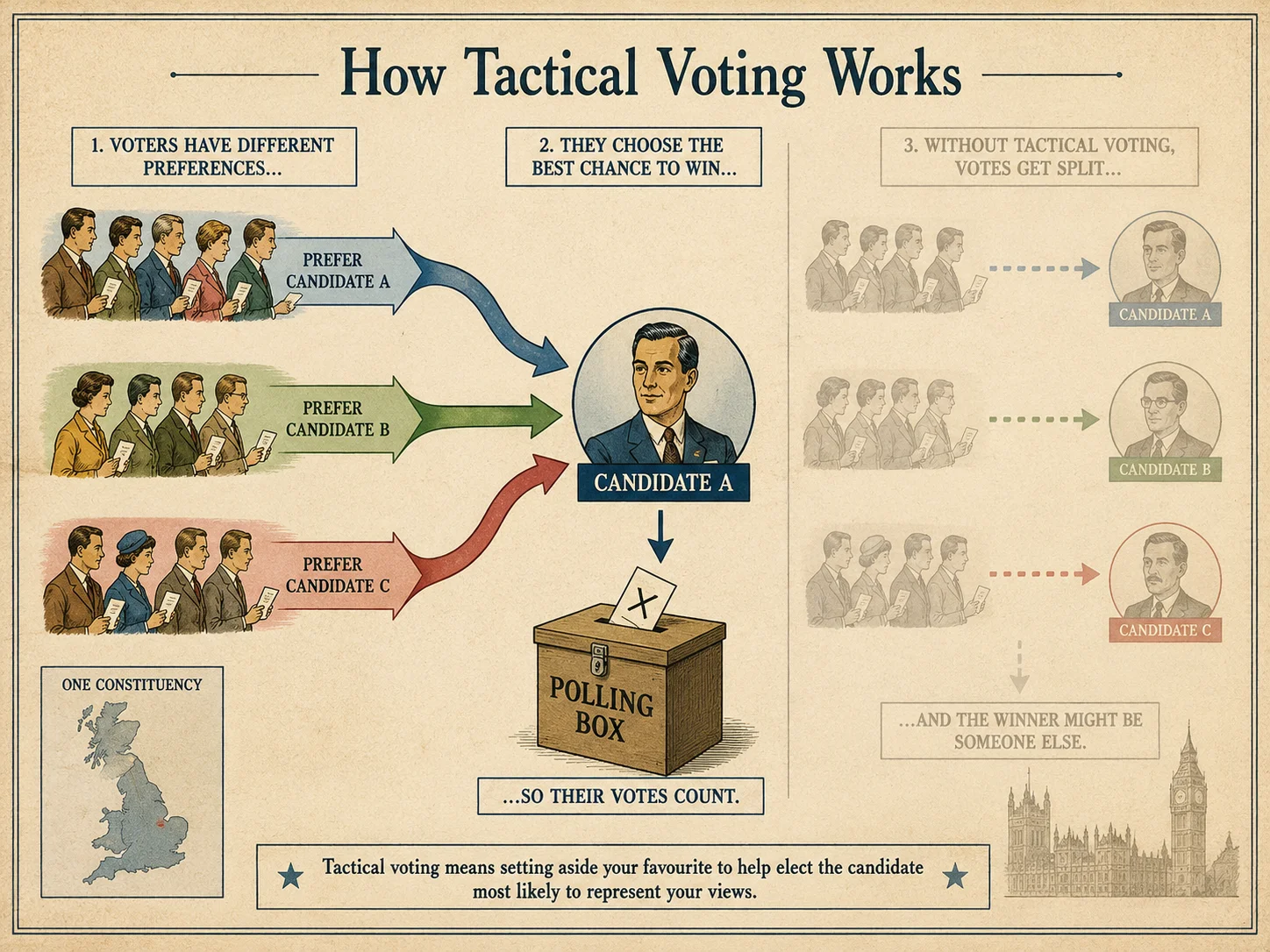
Tactical voting means voting with a practical goal in mind.
You may prefer one candidate most. If that candidate has little chance of
winning in your constituency, you may choose another candidate who has a better
chance of producing the result you want.
That is the basic idea:
> Use your vote where it can have the most effect in your constituency.
It is sometimes called strategic voting. It is not a command, and it is not a
guarantee. It is a judgement about the local race.
In one constituency, tactical voting is about choosing the practical candidate with the strongest chance of producing your preferred result.
## Why it matters in UK general elections
UK general elections use First Past the Post for Westminster constituencies.
That means:
- each constituency elects one MP;
- each voter chooses one candidate;
- the candidate with the most votes wins;
- the winner does not need more than half the votes.
So the local question is not always only:
> Which candidate do I like most?
It can also become:
> Which candidate has the best chance of getting the result I want here?
That is where tactical voting comes in.
## A simple example
Imagine this constituency result:
| Candidate | Votes |
|---|---:|
| Candidate A | 18,000 |
| Candidate B | 17,000 |
| Candidate C | 5,000 |
Candidate A wins.
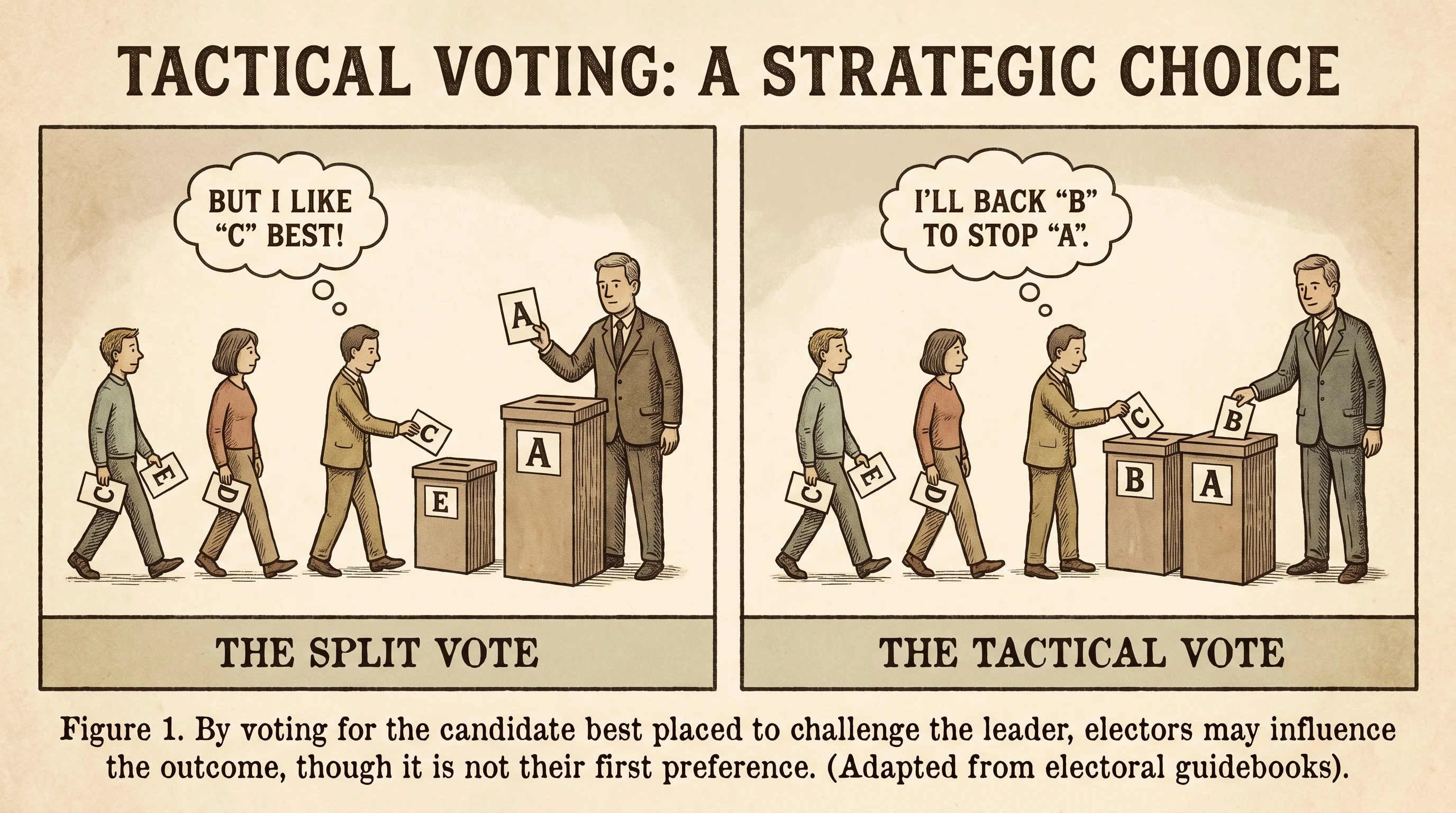
Candidate C did not come close. If enough Candidate C voters strongly preferred
Candidate B over Candidate A, some of them may decide next time to vote for
Candidate B instead.
That does not mean Candidate B is their perfect choice. It means Candidate B is
the practical choice if their priority is stopping Candidate A.
## Vote splitting
Vote splitting happens when voters with similar aims divide their support
between multiple candidates.
Example:
| Candidate | Broad lane | Votes |
|---|---|---:|
| Candidate A | Lane 1 | 16,000 |
| Candidate B | Lane 2 | 10,000 |
| Candidate C | Lane 2 | 9,000 |
Candidate A wins with 16,000 votes.
Candidate B and Candidate C together received 19,000 votes, but the votes did
not combine. Under First Past the Post, candidates are counted separately.
PollSignal focuses on this problem for right-of-centre voters. In some seats,
Conservative, Reform, or another right-of-centre candidate may be competing for
similar voters. If that support is split, a different candidate can win.
Vote splitting is local. Tactical voting asks which acceptable candidate has the strongest practical route in that constituency.
## What "best placed" means
When PollSignal says a candidate appears best placed, it means the available
evidence points to that candidate as the strongest realistic option in that
constituency.
It does not mean:
- the candidate is perfect;
- the candidate is certain to win;
- every voter should support them;
- the future is known.
It means the local evidence currently points that way.
Think of it like a weather forecast. A forecast can say rain is expected, but it
cannot guarantee the weather. Election recommendations are similar. They are
evidence-based judgements, not promises.
## Why confidence matters
Not every seat is equally clear.
Some races are straightforward:
| Candidate | Estimated support |
|---|---:|
| Candidate A | 45% |
| Candidate B | 25% |
| Candidate C | 10% |
Other races are messy:
| Candidate | Estimated support |
|---|---:|
| Candidate A | 31% |
| Candidate B | 30% |
| Candidate C | 28% |
In the second case, a responsible tactical voting tool should be careful. It may
say "too close to call" or "insufficient data" rather than pretending the answer
is clear.
PollSignal uses confidence ratings because data quality varies by constituency.
Past results, current polling, candidate strength, boundary changes, and local
campaigns can all affect the picture.
## What PollSignal checks
For each constituency, PollSignal may consider:
- the latest known candidates;
- the most recent general election result;
- boundary changes and notional results where relevant;
- current polling or forecasts where reuse is permitted;
- national polling trends;
- local candidate strength;
- whether right-of-centre support appears split;
- whether the evidence is current enough;
- whether a human editor has reviewed the recommendation.
The outcome can be:
| Outcome | Meaning |
|---|---|
| **Recommended tactical vote** | One right-of-centre candidate appears strongest locally. |
| **Too close / insufficient data** | The evidence is unclear, stale, weak, or too close. |
| **No realistic right-of-centre path** | No right-of-centre candidate appears competitive enough for a useful recommendation. |
## How to read a recommendation
When you see a constituency recommendation, check five things.
### 1. Constituency
Tactical voting is local. A party can be strong nationally and weak in your
seat, or the other way around.
### 2. Candidates
You vote for a candidate, not only a party label. Candidate quality and local
profile can matter.
### 3. Evidence
Past results are useful, but they are not enough on their own. Current polling,
forecasts, candidate data, and local information may change the picture.
### 4. Confidence
High confidence is different from low confidence. A low-confidence
recommendation should be treated carefully.
### 5. Last reviewed date
Election information changes quickly. Always check when the recommendation was
last reviewed.
## When tactical voting may make sense
Tactical voting may make sense when:
- your favourite candidate is unlikely to win;
- another acceptable candidate has a better chance;
- you strongly care about stopping a different outcome;
- the constituency is competitive;
- the evidence is reasonably clear.
The key word is "may". It depends on the seat and your priorities.
## When it may not make sense
Tactical voting may not make sense when:
- your favourite candidate has a real chance;
- the evidence is too weak;
- the race is not competitive;
- the tactical candidate is unacceptable to you;
- you care more about showing support than affecting the winner;
- you do not trust the recommendation.
That is a valid choice. The vote is yours.
## Tactical voting is not magic
Tactical voting can matter, but it has limits.
It cannot:
- predict every voter;
- force people to coordinate;
- guarantee a result;
- fix bad data;
- make a weak candidate strong;
- remove uncertainty.
A good tactical voting tool should show the difference between a clear seat and
an uncertain one.
## Glossary
| Term | Meaning |
|---|---|
| **Constituency** | The local area that elects one MP. |
| **MP** | Member of Parliament. |
| **Candidate** | A person standing in the election. |
| **First Past the Post** | The system where the candidate with the most votes in the constituency wins. |
| **Tactical voting** | Voting for a candidate who is not necessarily your first choice because they may have a better chance of producing the result you want. |
| **Vote splitting** | Similar voters dividing their support between different candidates. |
| **Confidence rating** | A signal of how strong or weak the evidence behind a recommendation is. |
## Further reading
- [UK Parliament: Voting systems in the UK](https://www.parliament.uk/about/how/elections-and-voting/voting-systems/)
- [Electoral Reform Society: First Past the Post](https://electoral-reform.org.uk/voting-systems/types-of-voting-system/first-past-the-post/)
- [Electoral Reform Society: What is tactical voting?](https://electoral-reform.org.uk/what-is-tactical-voting-and-why-is-it-bad-for-democracy/)